Family First
DESIGNING THE MODERN JOINT FAMILY
Creating Systems, Freedom, and Fairness for a New Era
By Rahul Kapoor
Love alone is not enough.
Tradition alone won’t sustain.
For today’s joint families to survive—and
thrive—they must be designed.
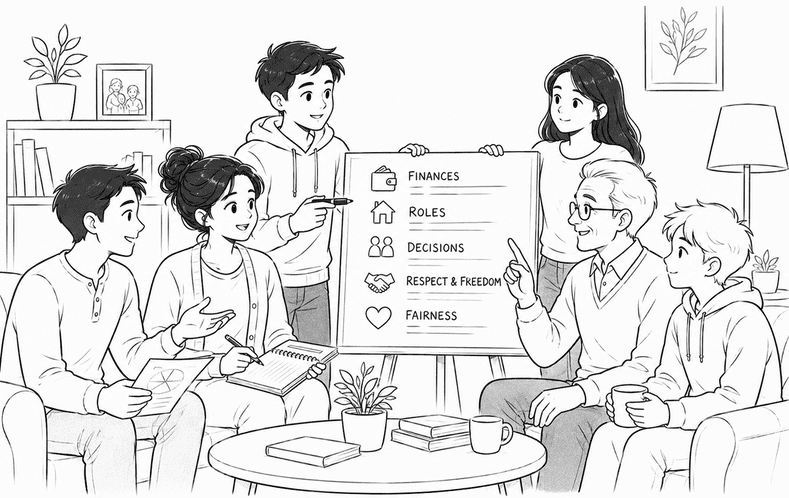
The joint families of the past were often driven by obedience, hierarchy, fear, or compulsion. That model doesn’t work anymore. The modern joint family must be collaborative, structured, and emotionally intelligent, where tradition meets design and freedom walks hand in hand with fairness.
Just like successful organizations and communities evolve with the times, families too must upgrade. Without systems, the best of intentions can collapse under emotional chaos.
The Three Pillars of a Modern Joint Family
1. Systems – Design Brings Clarity
Families must operate with clear, mutually agreed systems. Without them, decision-making becomes chaotic, roles become confused, and emotional turbulence increases.
Here are the minimum systems every modern joint family must have:
- Financial System: How income is pooled, expenses handled, and transparency ensured
- Household System: Clear roles for managing daily responsibilities without burdening a few
- Conflict Resolution System: Mechanism for conversations, mediation, and course correction
- Decision-Making System: A rotating “governing board” of 3–5 family members for major calls
- Family Meetings: Monthly discussions on logistics, emotions, and alignment
2. Freedom – Without It, Love Suffocates
Freedom is not separation.
Freedom is
being allowed to grow while staying
together.
Every person in a joint family deserves:
- Space for their career, spirituality, social life, and habits
- Respect for their choices—food, clothing, schedules, and beliefs
- The right to raise their children without unsolicited interference
Without freedom, families choke on expectations. With freedom, they breathe loyalty and grow naturally.
3. Fairness – Equity, Not Equality
Fairness means respect across all roles, not just the earning members.
- Homemakers deserve the same voice as professionals.
- Elders must be honored, but not entitled to control.
- Rotation of leadership for events creates inclusion.
- Property distribution should be based on equity, not ego.
When everyone feels seen, heard, and valued, the family operates from a place of abundance—not competition.
Real-World Family Innovation: What It Looks Like
Here are actual practices from modern joint families I’ve worked with:
- Every couple contributes a fixed % of income to a shared family pool
- A rotating board of decision-makers ensures shared leadership
- Sunday brunches as rituals, with time for personal space too
- Emotional boundaries—parents parent their own kids, others support without control
- Joint vacations with individual timeouts built in
A Case Study That Changed Everything
One family I worked with—just two parents, their children, and spouses—was on the verge of collapse. Constant arguments, walking out, emotional shutdowns, weeks of silence.
We stepped in with a simple but powerful intervention:
- A 3-day intensive retreat with psychometric assessments, so each person understood why they behave the way they do
- Structured sessions to talk, listen, and express expectations
- Spiritual insights, appreciation exercises, and tools for creating happy brain chemicals
- A journey of 11 deep conversations that uncovered stories, shared dreams, and family wisdom
This led to the birth of:
- Family Values they could all align with
- A Family Constitution
- A Governance Framework
- A Conflict-Resolution Mechanism
The result?
From breakdown to breakthrough.
From chaos to deep connection.
From a family on the edge, to a family that now
thrives—personally, emotionally, and financially.
REFLECT
- Are you relying on love alone to keep your family together?
- Do you have systems—or are you winging everything?
- Is your family model built for yesterday’s world or tomorrow’s?
REMEMBER
Strong families don’t happen by default. They
are designed with thought, intention, and love in
action.
Tradition must walk with transformation.
Emotion must be supported with structure.
Only then can we raise families that last.
TAKEAWAYS
- Build your family on three pillars: Systems, Freedom, and Fairness
- Create clear frameworks: finance, roles, decision-making, and conflict resolution
- Allow people space to grow, while keeping emotional closeness alive
- Make fairness a value—not just in words, but in decisions and distribution
- Remember: A great family is not the one that looks perfect—it’s the one that’s consciously created