Family First
HARMONY ISN’T AUTOMATIC
Why great joint families are consciously created—not inherited
By Rahul Kapoor
Many joint families believe they’re bonded by
tradition, culture, or shared values.
But that’s the illusion. The truth?
Harmony is never automatic. It is always
intentional.
We assume that just because we grew up together, prayed
together, celebrated together—we’ll stay
together.
But families don’t fall apart because people are
bad.
They fall apart because people are
unaware—of emotions, expectations, and
communication blind spots.
The Myth of “We’ll Be Fine”
Behind closed doors, even the most loving families face friction:
- Misunderstandings
- Passive aggression
- Unspoken resentment
- Personality clashes
- Parenting differences
- Communication styles that don’t match
These aren’t dramatic explosions. They’re quiet leaks. And when ignored for too long, they erupt like emotional tsunamis—leaving families confused and broken.
We think love is enough. It’s not.
Joint families require skills,
awareness, and
shared agreements.
Without that, even the closest families drift.
Conscious Families Create Conscious Cultures
While touring with one of my global programs, I had the privilege of meeting a few exceptional joint families—not clients, just people I observed and learned from. These weren’t families in crisis. In fact, they were thriving. What made them different?
They had a system. They had a culture.
In one such family, three brothers ran three different
businesses—each pursuing his own passion. There
was no pressure to join a central family venture.
Each received seed capital, with clarity: grow it,
return it, and then enjoy full freedom with your
profits. If it didn’t work, they were welcomed
back without judgment.
What amazed me wasn’t just the financial model—it was the emotional maturity in the home.
- The women were free to choose their paths—homemakers, professionals, students, or creatives.
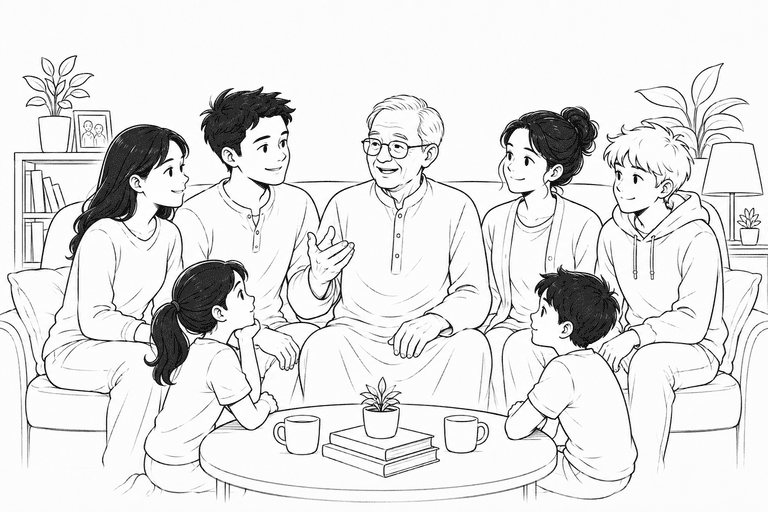
- Every weekend, the entire family gathered—no agenda, just presence. They spoke about challenges, hopes, goals.
- The children observed, listened, and absorbed a way of living that balanced love with respect and freedom.
There were barely any raised voices. Not because there were no disagreements—but because there was always someone present. Someone wise. Someone who listened.
The Power of a Mentor Within
At the heart of that family was a central
figure—a grandfather.
He wasn’t controlling. He wasn’t loud.
But he was steady, grounded, compassionate, and deeply
respected.
He didn’t enforce harmony. He inspired it.
His quiet presence held the family together like a
gentle magnet.
And when I studied their way of life, I realised: this
wasn’t luck.
It was
culture, consistency, and consciousness.
REFLECT
Do you believe harmony just “happens”?
Is there someone in your family playing the role of
anchor—or does everyone assume it will sort
itself out?
What structures or rituals could help you move from assumption to intention?
REMEMBER
Harmony isn’t inherited.
It’s built—through presence, patience, and
practices.
One conscious person can hold a family together. But a
conscious system can sustain it for generations.
TAKEAWAYS
- Love is not enough. Families need communication tools, shared rituals, and emotional intelligence.
- One anchor matters. A mentor-like presence—be it grandfather, parent, or elder sibling—can set the tone for the entire family.
- Structures build safety. Weekly check-ins, freedom of choice, and mutual respect are not accidental—they must be designed.
- Harmony is a skill. And like all skills, it can be taught, learned, and practised.
Joint families that last aren’t lucky.
They’re built, brick by brick,
on the foundation of conscious values and consistent
effort.