Family First
UNITY ≠ UNIFORMITY
Why accepting differences is the real strength of a modern joint family
By Rahul Kapoor
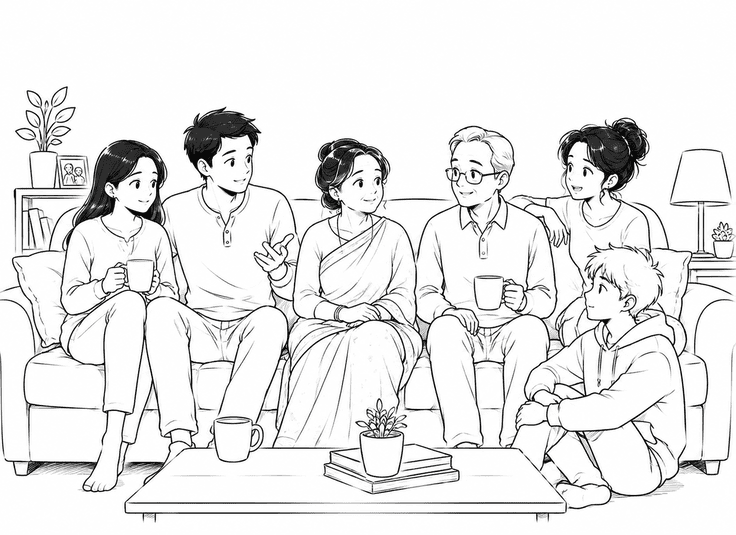
Many joint families don’t break because of
external pressure.
They collapse because of internal
rigidity.
At the heart of this collapse is a common misunderstanding—confusing unity with uniformity. The belief that everyone must eat the same food, follow the same routines, have the same opinions, live the same lifestyle.
But here’s the truth:
Real unity has space for real
individuality.
Diversity Isn’t a Threat—It’s a Strength
A modern joint family will have:
- Someone who is vegan, and someone who loves their biryani
- A saree-clad homemaker and a jeans-wearing entrepreneur
- A professional working in corporate life and someone building the family business
- One who wakes at 5 AM and another who functions best after midnight
This is not disintegration.
This is evolution.
And the families that thrive today are the ones that
build
psychological space without needing physical
separation.
The older mindset says: “We must all be the same
to stay together.”
The wiser mindset says: “We can be ourselves and
still belong to each other.”
The Myth of ‘One Formula Fits All’
Yes, there must be
non-negotiables—core values like
honesty, mutual respect, rituals, and contribution to
the family.
But lifestyle choices? Those must be
allowed to vary.
Because when you impose a one-size-fits-all model in today’s world, you're not creating harmony—you're breeding rebellion.
A Real Story: Two Brothers, Two Lives, One Bond
I worked closely with a joint family that exemplifies this new mindset.
Two brothers, living together with their families.
One is a fitness enthusiast—up at 5:30 AM, out
for marathons, structured vacations, disciplined
work-life balance.
The other? A night owl—social gatherings every
weekend, late-night Netflix binges, laid-back yet
effective.
Their wives are just as different:
- One prefers hiring a cook and household help so she can focus on work
- The other enjoys doing everything herself and finds joy in managing the home hands-on
- One spends her time with friends and social circles
- The other treasures time with her mother-in-law and caring for the kids
Despite their contrasting preferences, their shared respect, emotional maturity, and alignment to family values keep them united.
Different rhythms.
Different styles.
Same core.
This is what makes their family resilient—and beautiful.
The Deeper Problem: Emotional Insecurity
Often, the need for uniformity comes from a place of fear:
- “If they do it differently, they might stop valuing what I value.”
- “If I allow this, where do we draw the line?”
- “If they change, maybe I’m becoming irrelevant.”
But here’s what we must understand:
Different does not mean disrespectful.
Disagreement is not disloyalty.
And
individuality is not a threat—it’s an
asset.
When we let go of the belief that “my way is the right way”, we make room for deeper love, broader understanding, and lasting bonds.
REFLECT
- Are you trying to force sameness in the name of unity?
- Do you assume someone’s different lifestyle is a sign of rebellion?
- What choices can you respect more, even if you don’t relate to them?
REMEMBER
The future of joint families depends on this
truth:
Unity is about shared values, not identical
routines.
When people feel free to be themselves and still be
accepted, they choose to stay.
TAKEAWAYS
- Don’t confuse harmony with sameness—diversity is healthy.
- Align on family values, not lifestyle details.
- Stop assuming different means disrespectful.
- Create space for each person to grow in their own way.
- A modern joint family is one where freedom and belonging co-exist.