Family First
THE SILENT WAR OF COMPARISON
Why measuring family members against each other breaks more than it builds
By Rahul Kapoor
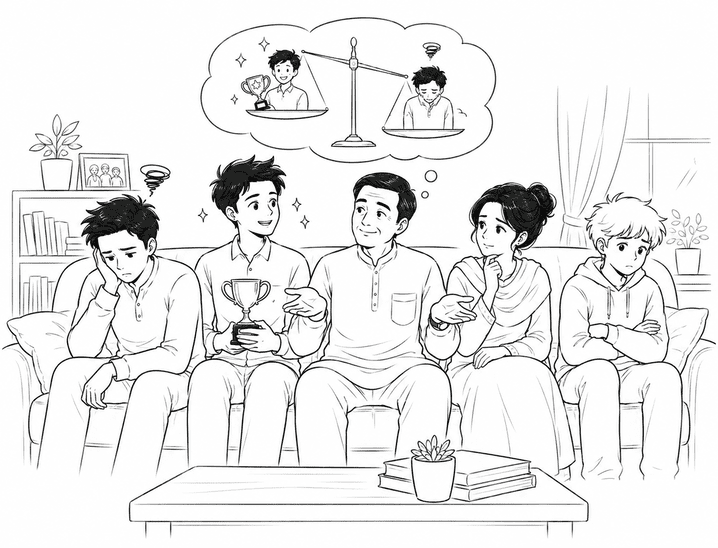
Of all the toxins that quietly damage joint families, comparison ranks among the deadliest.
It arrives silently—through a casual remark, a
gesture of praise, or a pointed question.
“Why can’t you be more like him?”
“She’s always helping. What about
you?”
“He earns more. You should learn something from
him.”
What seems like motivation becomes a lifetime of damage.
The Poison of Unfair Expectations
In one of the most intense family interventions I’ve led, the issue wasn’t property disputes or business strategy—it was comparison. A constant, unspoken ranking system. Who earns more. Who helps more. Who sacrifices more.
It was a wealthy family—two sons, both married, both part of the business. On paper, they had it all. But within the home, the air was thick with emotional exhaustion.
The elder son mirrored his father—disciplined,
driven, sharp. He woke early, led meetings, delivered
results. Naturally, his father celebrated him.
“He’s just like me,” he’d beam
at business gatherings.
The younger one was different—kind-hearted, intuitive, more balanced. But not fast-paced. Not cutthroat. His strengths were softer, invisible in the family’s definition of “success.” He felt perpetually inadequate, compared, sidelined. The more he was pushed, the more he withdrew.
He stopped showing up on time. Skipped meals with the family. Took refuge in the gym, in expensive distractions, in friends outside the circle. His silence wasn’t laziness—it was quiet rebellion.
The Truth Most Families Miss
Not everyone in a joint family has the same capacity—mental, emotional, spiritual, intellectual. And yet, we expect all to perform the same roles, with the same energy.
It’s like asking every player on a cricket team to be a captain, a wicketkeeper, and a star batsman—all at once. That’s not teamwork. That’s a recipe for chaos.
Joint families thrive not on equality of output, but on alignment of roles based on capability and contribution.
Yes, there must be accountability. No, laziness shouldn’t be excused. But when capability differs, responsibility must be customised—not standardised.
Astrology adds another layer. Not everyone understands this, but some members may go through planetary phases—like Sade Sati, Rahu Dasha, or Shani Mahadasha—that naturally make life harder. They’re not making excuses; they’re navigating storms you can’t see.
A Story of Balance
In contrast, another billionaire family I worked with had two sons as well—but the parents were wise. From teenage years, both sons were involved in business conversations. No child was made to feel inferior. Each was celebrated for unique strengths.
One mastered numbers, strategy, and risk. The other shone in marketing, relationships, and customer loyalty. When they returned from top MBA programs, the roles were already outlined—clearly and respectfully.
There was no need for comparison. And so, there was no resentment. The business scaled rapidly. The family stayed intact.
REFLECT
Are you comparing members of your family—subtly
or openly?
Is someone in your home quietly suffering because of
it?
Could individual strengths be better respected, not
ranked?
REMEMBER
Comparison destroys creativity.
Respecting unique abilities builds contribution.
Even the same sun doesn’t shine equally on every
day.
TAKEAWAYS
- Comparison is corrosive. It breeds insecurity, resistance, and emotional detachment.
- Tailored roles empower people. Like in sports, everyone doesn’t play the same role—yet everyone can be vital to the team.
- Avoid public praise that becomes private pain. When one member is always spotlighted, others silently shrink.
Joint families aren’t built on sameness. They thrive on understanding, empathy, and differentiated contribution.