Family First
DAUGHTER-IN-LAW ≠ DOMESTIC HELP
Shifting the mindset from duty to dignity
By Rahul Kapoor
Let's go back 30 or 40 years.
In most joint families, there was a simple social
equation:
Men worked outside. Women held the home.
And they did so with grace, grit, and quiet
brilliance.
They weren't just homemakers, they were the emotional
anchors who gave men the confidence to take risks,
build businesses, and create abundance.
But there was a silent trade-off.
In the name of duty, women often sacrificed personal freedom. In the name of responsibility, love often took the form of control. And in the name of tradition, many daughters-in-law were treated more like domestic help than like family.
How Dominance Masqueraded as Love
In many families, the mother-in-law became the center of the household - not out of ego, but out of necessity. With men away at work, she had to manage everything - finances, rituals, safety, and emotional balance.
But over time, this responsibility hardened into dominance.
She began controlling the kitchen, the daily routine, even the emotions of the house - often believing that love meant supervision, and order meant power.
So when a new woman—her daughter-in-law—entered the family, insecurity crept in. Would she lose her influence? Her son's affection? Her place in the family hierarchy?
To protect that space, control increased, and freedom decreased, especially for the daughter-in-law.
What started as care turned into conditions.
What should have been inclusion turned into
invisible exile.
A Present-Day Story That Still Hurts
This isn't history. It's happening now - in Tier 1 cities, in well-educated homes, in respected families.
A case I worked on involved a young, educated woman married into a prominent family. Despite her qualifications and warmth, she was treated like an outsider.
- She wasn't allowed to sit on the sofa with the rest of the family.
- She had to serve everyone before eating, no matter how late or hungry she was.
- Going out required permission. Holidays were scrutinised.
- She had no financial freedom. No voice in family decisions. No real sense of belonging.
And yet, the family didn't see the problem.
Because they thought this was normal.
Because this is how they had lived.
But times have changed.
Evolving the Definition of Family
Today's women are educated, exposed, expressive, and independent. They bring ideas, not just effort. They don't need permission - they seek partnership. And if joint families want to thrive, they must transform.
This starts with one simple truth:
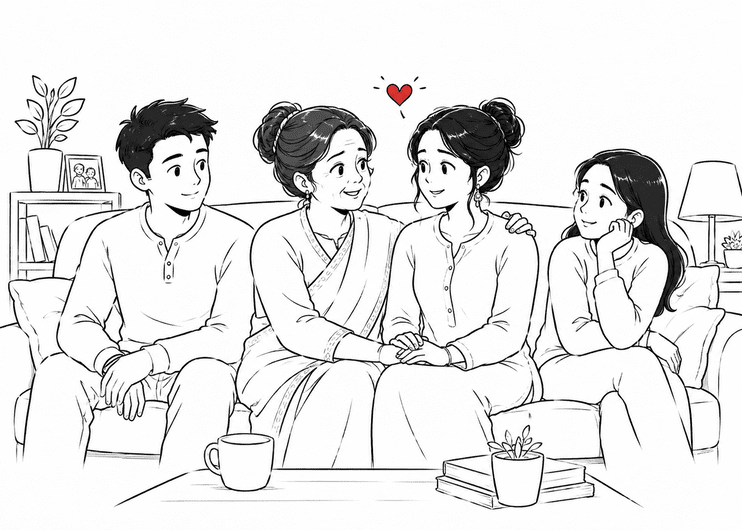
You are not bringing home a domestic help.
You are welcoming a daughter-in-love.
She's not here to just serve. She's here to grow with the family - to love your son, respect your values, and co-create a home that reflects mutual dignity.
That means:
- Giving her space to adjust
- Learning about her world as much as she learns yours
- Letting her contribute beyond the kitchen
- Trusting her to make decisions
- Treating her like a human, not a helper
When families do this, transformation isn't gradual - it's dramatic.
Because when daughters-in-law are treated with respect and equality, they don't just survive, they shine. And the entire family shines with them.
REFLECT
- Are the expectations you place on your daughter-in-law rooted in tradition or insecurity?
- Does she feel safe, seen, and supported in your home?
- If she were your own daughter, would you accept the way she's being treated?
REMEMBER
You're not welcoming a maid—you're inviting a
future matriarch.
Treat her like family, and she will help your family
flourish.
TAKEAWAYS
- Dominance is not love. Control-based care only creates distance, not connection.
- Upgrade the mindset. Today's daughters-in-law are equals—treat them with dignity, not duty.
- Inclusion is the foundation. When you welcome her as a daughter-in-love, the entire family rises.