Family First
SON OR SUPERMAN?
When One Man Carries the Weight of the Whole Family
By Rahul Kapoor
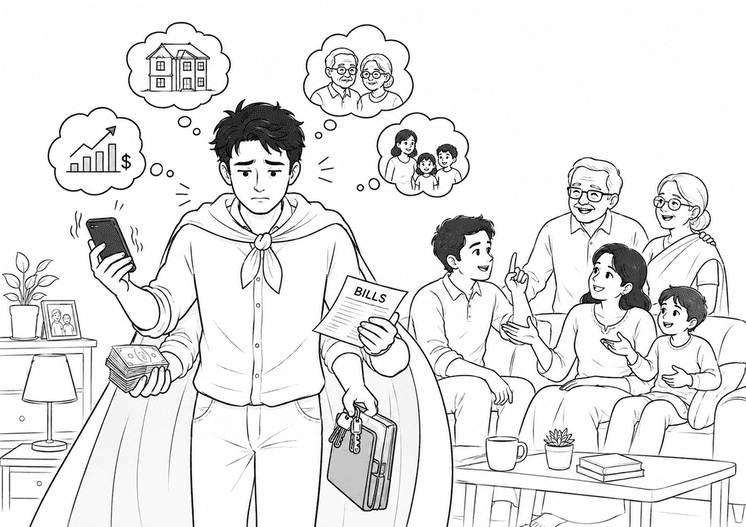
In many joint families, especially traditional ones, there often emerges one son who is silently nominated as the ‘go-to guy.’ He becomes the default problem solver—financially, emotionally, and even logistically.
This is the man everyone turns to when things go wrong. He might be the eldest son, or sometimes even the second, but over time, he's the one who takes charge of the family business, leads key decisions, and is expected to maintain family unity.
Married into Responsibility
If he is handed this responsibility before marriage, he may carry it lightly, with enthusiasm and idealism.
But once he is married, the pressure multiplies. He now balances multiple roles—business leader, family caretaker, husband, and perhaps a father.
He works long hours, ensures bills are paid, elders are cared for, and family disputes are resolved. But in doing so, he rarely makes space for his own rest, hobbies, or privacy.
The Superman Burnout
What starts as service slowly turns into silent suffering.
This “superman” cannot say no. He says yes to everything, and over time, people begin to take him for granted. The cost? His health, his joy, sometimes even his marriage. His children may feel ignored. His spouse may feel lonely.
And eventually, he either explodes in anger—or implodes into silence. Both are dangerous.
When the Father Passes
The pressure intensifies when the patriarch passes away. If one son suddenly inherits both business and emotional leadership, it can become overwhelming. He may make sacrifices for the family, but silently resent them.
He becomes a fixture—ever-present, ever-reliable, and eventually… ever-drained.
The Alternative: A Super Family
Families don't need a superman. They need shared responsibility.
Today, help is available.
- Family businesses can hire professionals.
- Coaches can guide family roles.
- Family governance models like Family Charters can offer clarity.
When roles are discussed, documented, and delegated, families shift from relying on one man… to becoming one united team.
A Real Family Story
In one family we worked with—two parents, four sons, their wives, and three grandchildren—the business expansion failed, and they went into debt.
It was the eldest son who silently took the load. He worked day and night, shielding others from stress, until he nearly collapsed.
That's when we helped facilitate a family conversation. Everyone stepped up—men, women, young and old. Responsibilities were divided, financial clarity restored, and most importantly, the emotional burden was shared.
This moment of crisis became their turning point. They moved from superman to super-family.
REFLECT
- Are you the “default problem-solver” in your family?
- Is your help empowering others—or enabling their dependence?
- Have you given your family a chance to support you?
REMEMBER
The strongest pillar still needs a foundation. No one can carry a family alone—not without cracking somewhere.
TAKEAWAYS
- Emotional responsibility must be shared, not assigned.
- Saying “yes” to everything often means saying “no” to yourself.
- Respect is mutual; it doesn't come only from sacrifice.