Family First
ROLE CLARITY IN A JOINT FAMILY
Who does what—and why it matters for peace
By Rahul Kapoor
It was one of the most transformative joint family projects I've worked on. The engagement lasted 12 months—but the lessons will last me a lifetime.
Until then, I was known as a speaker—passionate about family harmony and emotional well-being. But this assignment took me far from the stage and deep into the real world of a joint family navigating invisible chaos.
Two brothers, their spouses, and four young adults—all under one roof, and all part of a successful business. From the outside, they looked ideal. Respected in society. Business thriving. Family photos full of smiles.
But behind closed doors, something was missing.
The Silent Breakdown
When I stepped in, a top consulting firm had just
wrapped up a one-year transformation project for
their business. Their final report ended with a
line that hit me like a thunderclap:
"It's almost not difficult, but
impossible—because they don't even look each
other in the eye."
That's when I was brought in—not just to coach the next-gen, but to realign the entire family. The real issue? Not money. Not ambition. Not ego.
It was role confusion.
Each adult had joined the business at different times. Each had distinct strengths. But without clear responsibilities, recognition systems, or communication rituals, the foundation had quietly started to erode.
There were assumptions. Unspoken frustrations.
Misplaced expectations.
The shared dream had turned into parallel efforts,
each pulling in a different direction.
Mapping the Unseen
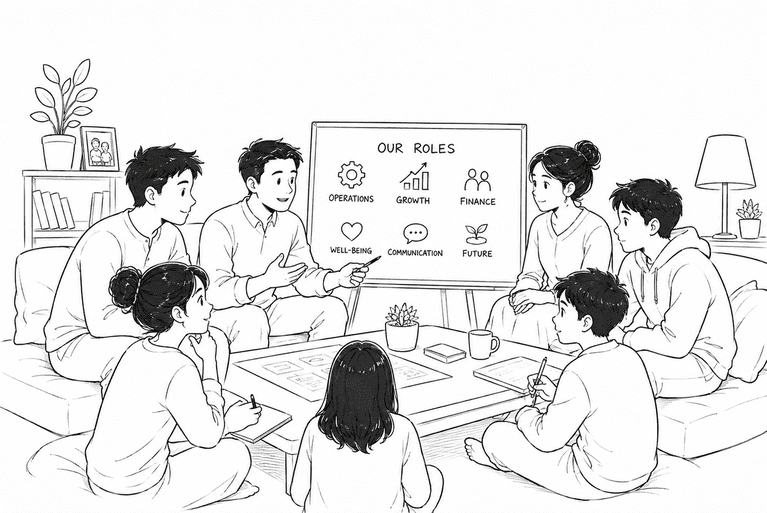
We began with a three-day offsite retreat. Here, everyone had space to share—goals, pain points, and unspoken dreams.
The two brothers were brilliant in different ways—one was a master of systems; the other, a natural at business expansion. But no one knew who was steering what. Decision-making became blurred. Accountability was missing. And growth felt heavy.
It didn't stop there. The spouses weren't sure if they were expected to focus on home, business, or both. The four next-gen members floated in undefined zones—unclear about where they belonged or how to contribute.
One had launched a side venture but lacked support. Another had technical talent but no roadmap. A third was spirited but raw. And the fourth had fire and energy—but no defined role.
So, we created a structure.
Each member articulated their values, vision, and strengths. We then mapped roles—not just for today, but for the family's future.
From Confusion to Coherence
Bit by bit, things began to shift. Roles got clearer. Boundaries were respected. Decision-making frameworks were set. Even the women—usually excluded from business matters—were integrated into governance, their voices shaping important decisions.
Over a year, the "impossible" became a new way of
being.
All four next-gen members returned—with new
confidence and clarity.
The brothers doubled down on their natural
domains.
The spouses built connection rituals that revived
the emotional heartbeat of the family.
And for the first time in years, they began functioning—not just as a business or a bloodline—but as a living, breathing ecosystem.
When it was time for me to step away, the business
coaches stepped in.
I left knowing this family had not just found
structure.
They had found peace through clarity.
REFLECT
- Are roles clearly defined in your family—or silently assumed?
- Is each member contributing from their strengths—or just filling gaps?
- Could better role clarity improve your family's connection and progress?
REMEMBER
Families don't break because people are bad.
They break when expectations collide in the
absence of clarity.
Clarity is not control—it's care made visible.
TAKEAWAYS
- Unclear roles create silent tension. Role confusion is one of the most common causes of friction in joint families.
- Structure fuels freedom. Clearly defined roles unlock creativity, contribution, and confidence.
- Peace is built on clarity. The more open a family is about "who does what," the stronger the trust and alignment.