Family First
THE HEART OF THE JOINT FAMILY
Why this age-old system still matters today
By Rahul Kapoor
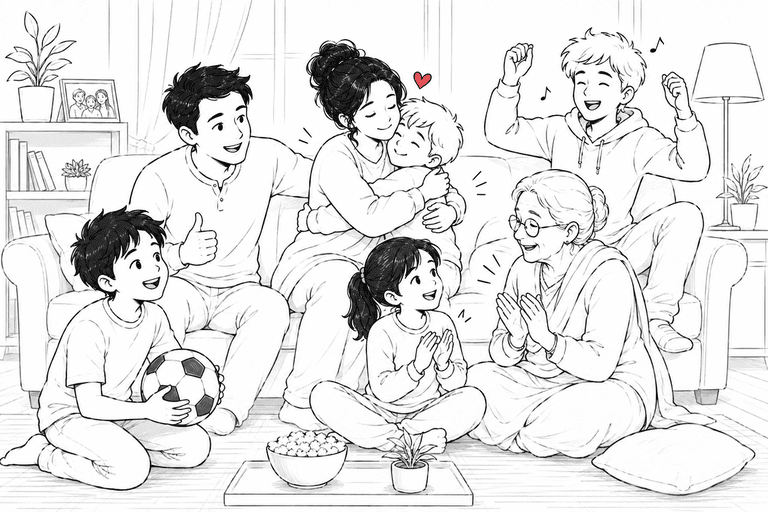
I was born into a joint family. Thirty-six of us lived under one roof. That was my world—where love, chaos, laughter, discipline, and the scent of fresh food all came together like a living symphony.
Living in such a dynamic environment gave me a rare perspective—not just intellectual understanding, but emotional immersion. I didn't study the joint family model—I experienced it, every single day.
A Legacy Rooted in Purpose
The roots of the joint family system trace back to the Vedic era. Back then, the family wasn't just a social arrangement—it was a sacred unit of Dharma (duty), Karma (right action), and Ashrama (life stages). These values weren't preached—they were lived.
Communities like the Marwaris, Jains, Agarwals, Sindhis, and Patels embraced this system not just as culture, but as strategy. It was their formula for collective strength—emotional, financial, and spiritual.
Men travelled the world for trade. Women held the home with grace and intelligence. Children learned life by observing—not through lectures, but through real conversations, real negotiations, real emotions.
There was trust. There was order. There was alignment.
But there were also challenges—deep, silent ones.
The Cracks in the Foundation
Even the most ideal joint families were not without their shadows. Privacy was limited. Hierarchy often muted individuality. Many women carried the weight of duty without room for ambition. Dominance was often masked as discipline. And those who didn't speak up were often left unheard and unseen.
As times changed, so did people.
With education, technology, and exposure came new questions:
Where is my space?
What about my dreams?
Why don't I feel seen?
And when those questions went unanswered, many joint families slowly fell apart—not from a lack of love, but from a lack of evolution.
A New Kind of Joint Family
Today, many view the joint family as an outdated concept. But I believe otherwise.
We don't need to abandon the joint family.
We need to reimagine it.
Over the past two decades, I've worked with families across generations who have reinvented this model. Families where:
- Grandparents offer wisdom, not interference
- Daughters-in-law are seen as partners, not just caregivers
- Sons respect space as much as they value support
- Children grow up with roots and wings
These families don't just survive—they thrive.
Not by holding on to tradition blindly, but by
upgrading it consciously.
They replace assumption with clarity.
Fear with trust.
Silence with open communication.
This chapter marks the beginning of one of the most intimate sections of this book—dedicated entirely to the world of joint families. Through real-life stories, emotional insights, and practical solutions, we'll explore how this beautiful, complex structure can once again become a powerful force for love, legacy, and leadership.
Because I've seen it with my own eyes—joint families
can still work beautifully.
They just need a new rhythm.
REFLECT
- What are your earliest memories of shared family life?
- Did you grow up in a joint or nuclear home—and how has that shaped you?
- If your extended family were to live together today, what would you preserve and what would you evolve?
REMEMBER
Joint families aren't outdated—they're just waiting for a new blueprint. One that honours both tradition and transformation.
TAKEAWAYS
- Tradition must evolve to stay alive. A joint family thrives when it honours its roots while embracing change.
- Shared space works only with shared clarity. Communication, mutual respect, and well-defined roles are essential.
- Legacy is a collective journey. It's built when generations trust, support, and grow with one another.