Family First
WHY DO PEOPLE LIE IN FAMILIES?
By Rahul Kapoor
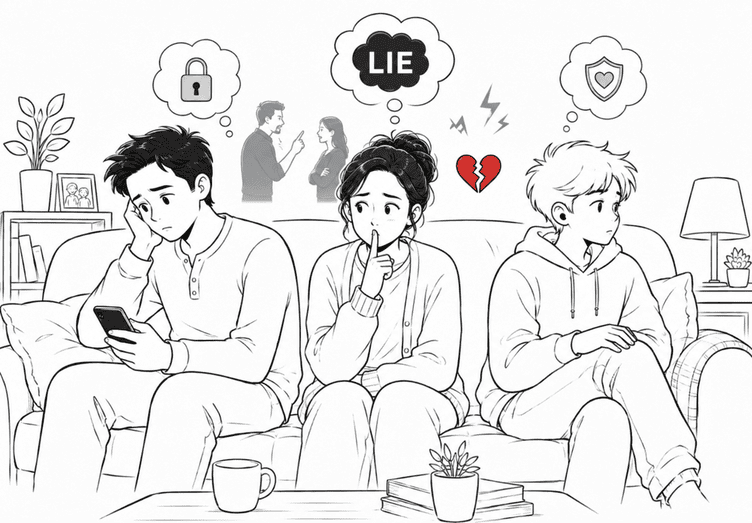
Lies don’t always come from deceit. Sometimes, they come from silence, fear, and survival.
Why do people lie in families?
Because - believe it or not - sometimes, they feel like they have no other choice.
It’s not always about deceiving others. More often, it’s a coping mechanism driven by fear, lack of psychological safety, or the inability to express themselves openly. Over time, they begin to believe that hiding the truth is the only way to avoid confrontation or pain.
Let’s take a closer look.
In families where dominance, strict control, or rigidity is the norm—where one person’s worldview is forced on others, without space for discussion—lying becomes a way to survive.
When every attempt at honest expression is met with conflict, aggression, criticism, or humiliation, people stop expressing. They shut down. And once that becomes the pattern - day after day, month after month, year after year, the mind simply concludes: “Better to lie than to fight.”
The Price of Perfection
I once worked with a family where the mother constantly complained that her children lied to her. One incident stuck with me: her daughter told her she was going on a college trip for two days but was actually spending time with her boyfriend. The mother was furious when she found out. But the father already knew and didn’t object.
Why did the daughter lie?
Because she feared the reaction, not because she wanted to betray her mother. Years of rigid parenting, expectations enforced without dialogue, and decisions made for her, not with her, had led the daughter to believe that honesty had no place in their relationship.
This is where it starts: good intentions delivered with poor methods.
Many parents, in their desire to raise successful, disciplined, value-driven children, forget to look at the child’s world. They enforce rules instead of having conversations. They lead with fear, not understanding. And the more successful or authoritative they are in the outside world, the more convinced they become that their way is the only way.
But each family member, each child, spouse, sibling is a different person. With different needs. Different emotions. Different coping styles. And when their truth is not welcome, they choose silence. Then hiding. Then lies.
Is it right? Not necessarily.
Is it cheating? Not quite.
It’s not cheating. It’s avoidance. It’s emotional protection. It’s a misguided attempt at keeping peace while sacrificing trust.
The sad part? It often causes more harm than the truth would have. And it must be addressed - not by punishment, but by building a new kind of space. A space where truth is safe. Where people feel seen, not judged. Where disagreement doesn’t feel like a warzone.
That takes maturity. Patience. A shift in the emotional climate of the home.
REFLECT
- Have you ever lied to avoid a fight? Why?
- Is your home a safe place for truth?
- How can you build more openness without fear?
REMEMBER
Behind most lies is a truth that didn’t feel safe enough to be said.
TAKEAWAYS
- Lying in families is often a coping mechanism, not an act of betrayal.
- Rigid control and dominance kill open communication.
- Truth needs psychological safety, build a home where it’s okay to speak up.