Family First
SAME FAMILY, DIFFERENT WORLDS
By Rahul Kapoor
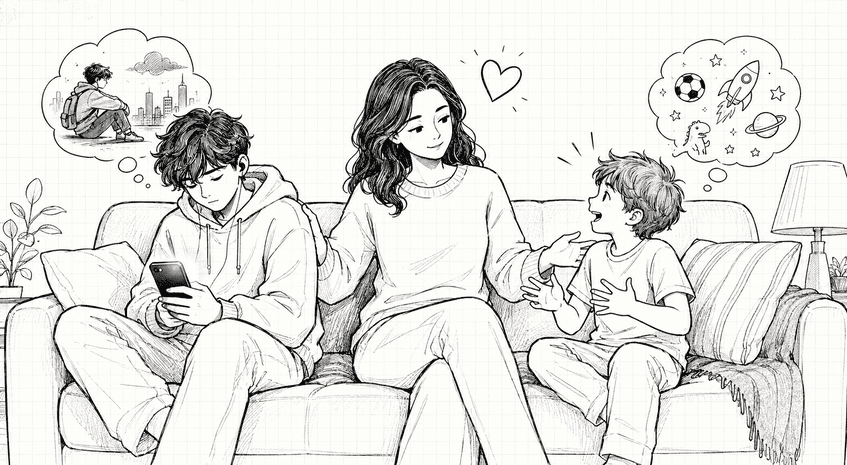
Understanding Your Children Without Comparison
If you have two children, you’ll know this already - no two are alike.
One might be shy, quiet, and thoughtful. The other might be louder, expressive, moody, or curious. One is stepping into early teens, still trying to figure things out. The other has just passed that stage and is trying to test limits, establish independence, and maybe even challenge authority - including yours.
As a parent, though, you often see them both as just that - children. Yours. You’ve raised them with love, care, and your values. So, somewhere deep inside, you expect them to behave in certain ways. And that’s where things begin to get complicated.
We tend to forget that our children are individuals - with different personalities, energies, thinking styles, and emotional needs. But what do most parents do? Compare.
One child seems more obedient, and suddenly they become the gold standard. The other is more unpredictable or expressive, and we start using phrases like:
“Why can’t you be more like your brother?”
“Your sister always listens.”
“At your age, I never behaved like this.”
We might mean well. We might just be venting. But what we don’t realise is that these words plant seeds of insecurity and resentment in our children.
They begin to feel like they’re not enough - not good enough, not smart enough, not “right” enough. And when they can’t explain how they feel, they carry that confusion within them... until it bursts out as rebellion, silence, withdrawal, or risky decisions.
The real trouble is this: when we can’t understand a behaviour, we get frustrated. Because we expected something else. Because we assumed that love alone would be enough to ensure respect and obedience. And when our children don’t meet those expectations, we’re not just disappointed in them - we’re disappointed in ourselves, too.
That frustration becomes criticism. That criticism becomes distance. And very soon, we’re all living in the same house, but speaking different languages - emotionally.
Children, especially teenagers, don’t always know how to handle this gap. So they escape. Sometimes it’s through friends who influence them poorly. Sometimes it’s through smokes, drinks, physical experimentation, or late-night parties. Sometimes it’s through endless scrolling on a screen, looking for validation they don’t feel at home.
And most of the time, we - the parents - miss the signs. Not because we’re careless. But because we’re stuck in a different time.
We keep comparing their lives to ours at that age.
“When I was your age, I studied hard. I respected my elders. I didn’t talk back.”
“We didn’t have mobile phones. We had discipline.”
All of that may be true. But that world is gone. It’s not coming back.
The kind of exposure, complexity, and distractions today’s kids face are far beyond anything we dealt with. So to expect them to behave like we did is not only unfair - it’s naive.
We’re asking them to play a game by rules that don’t apply anymore.
And if we keep doing that, we risk becoming emotionally outdated - dinosaurs in our own homes.
The only real answer? Adapt.
Learn. Evolve.
You don’t have to become your child’s best friend. But you do need to become someone they can trust. And that trust only grows when you stop comparing and start understanding.
There’s no perfect child. But there can be a far more aware parent.
And no, it won’t always be easy. But it’s necessary.
Because when we choose to adapt, when we learn to see our children as individuals - not as extensions of ourselves - we create space. Space for growth. Space for expression. Space for healing.
Parenting isn’t about forcing your children into your mould.
It’s about giving them strong roots and enough space to grow into who they are.
REFLECT:
- Do I unconsciously compare my children or even compare them to my younger self?
- Have I stopped listening because I think I already “know” them?
- What would shift if I started asking questions, instead of just giving instructions?
TAKEAWAY:
- You don’t raise children - you raise individuals. Each one deserves to be understood on their own terms.
- Your past may not be the best template for their present.
- Adaptability in parenting is not weakness. It’s wisdom.
- The best way to lead your children is not with control, but with connection.