Family First
REFRAMING: HOW CHANGING THE LENS CHANGES EVERYTHING
By Rahul Kapoor
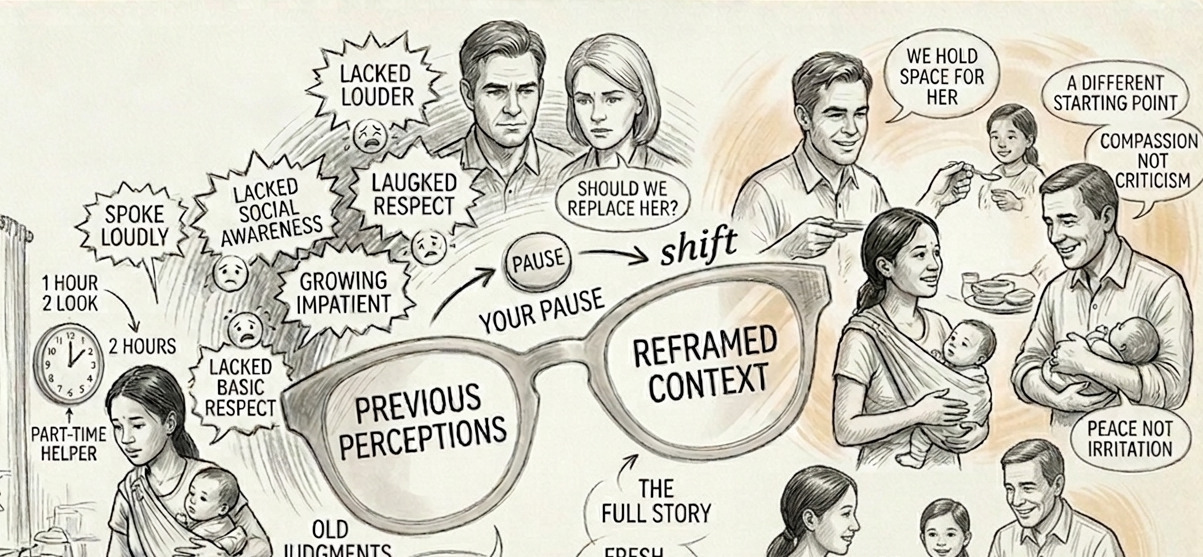
We often see people's behavior. But we rarely see what's behind it.
In families and even in our extended circles, we get so used to patterns that we stop asking why. We just react. Someone speaks loudly, we label them rude. Someone doesn't say thank you, we assume they're ungrateful. Someone loses their temper, we decide they're difficult.
But what if we paused and changed the lens? What if we didn't jump to conclusions, but instead reframed the way we saw the person?
The Girl Who Changed My Understanding
We had a part-time helper at home. She would come in for an hour or two, bringing her little baby along. She was efficient with her work, but there were certain things about her that would really bother me.
She spoke loudly. She laughed even louder. She lacked basic social awareness like toning things down when guests were around. She didn't always show the kind of courtesy or respect I'd expect from someone working in our home.
I found myself growing impatient.
I even asked my wife, "Should we replace her?"
We began looking for a replacement. But one day, out of curiosity, I struck up a conversation with her. What she said made me see her differently.
She told me she was from Nepal. Just 19 years old. Married at 16. A mother at 18. Now in India, working to support her baby and her family.
The more she spoke, the more my heart softened. I thought of my own daughters - young, sensitive, figuring life out one day at a time. And here was a girl, barely out of girlhood, carrying the responsibility of motherhood, working odd jobs just to stay afloat.
Suddenly, I wasn't looking at a loud helper. I was looking at a young girl. Someone who deserved understanding. Someone who wasn't just doing work, but surviving.
From that day forward, I could not see her the same way again. When her child cried, we picked her up and played with her. She began joining us for breakfast sometimes. We spoke to her with kindness. When she was loud or irritable, we didn't react - we responded with patience. We didn't adopt her. But we held space for her. We gave her something close to family.
That one shift in perspective, not in her behavior, brought peace where there was previously irritation. It wasn't her that changed. It was us. We reframed the context.
Why This Matters in Family Life
So often in family relationships, we get stuck in repetitive emotional loops:
- "He always does this."
- "She never listens."
- "They don't understand me."
We stop seeing the person behind the behavior. We see their reactions, not their reasons. But people are not problems. They are stories waiting to be heard. And often, their behavior is a symptom of a context we haven't yet understood.
Someone's mood could be shaped by:
- Hormonal imbalances
- Financial stress
- Work pressure
- Lack of sleep
- Relationship issues
- Loneliness
- Trauma they've never shared
And because they don't always express it in words, it comes out through tone, anger, detachment, or irritation. If we continue reacting without understanding, we only add to the mess. But if we pause and reframe, even without the full story, we begin to respond with compassion, not criticism.
Reframing Is a Choice
Reframing isn't about excusing bad behavior. It's about choosing a better
starting point.
Instead of reacting to what we see, we become curious about what we don't.
It sounds simple but it's not easy. Because it means dropping old judgments.
It means letting go of the version of the person we've been carrying in our
mind. But once you do that, even once, it can be a game changer.
REFLECT
- Who in your family triggers you the most? Can you pause and ask: What might be their story today?
- Is there a behavior that irritates you, but you've never explored what might be underneath it?
- Can you look at someone not through your past perception, but with fresh curiosity?
TAKEAWAYS
- Reframing helps shift your emotional response from frustration to understanding.
- People are not just their behaviors, they are shaped by context.
- When you stop expecting people to change, and start changing how you see them - relationships transform.
Peace doesn't come from changing others. It comes from seeing them with softer eyes. Try reframing one person this week. You might just rewrite the story for them and for yourself.