Family First
START WITH SELF: THE WINDOW TO HARMONY
By Rahul Kapoor

Most of us believe we’re doing our best when it comes to family. We care. We try. We repeat the same conversations. We fight for what we believe is right. And yet, despite the love and effort, peace often slips through the cracks.
Arguments come out of nowhere. Small misunderstandings become emotional minefields. Some people explode. Others go quiet. The emotional energy in the house rises and falls like unpredictable waves.
You may think, "Why is this happening again?" or "How did things get so complicated when all I wanted was a normal conversation?"
This is where we begin.
The goal isn't to fix anyone. Not your partner. Not your parents. Not your child.
The real work is to start seeing more clearly — yourself and others. And one of the most powerful tools I've come across in my own family life and in my work with thousands of people is something called Johari's Window.
The Tool That Helps You See
Johari's Window is a simple psychological model developed by Joseph Luft and Harrington Ingham. But don't let the academic name fool you — it's deeply practical for everyday family life.
It breaks your self-awareness into four areas:
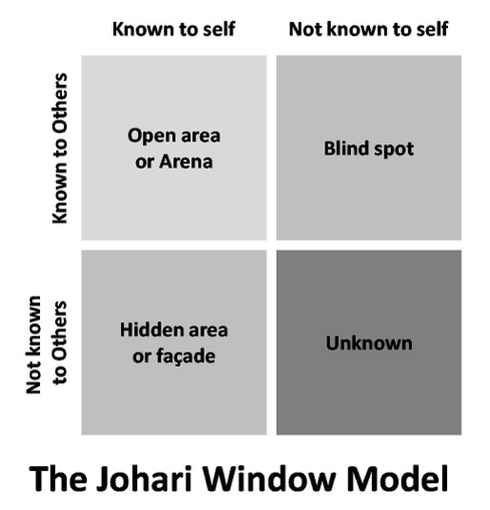
- Open Area – What you know about yourself and others also know
- Hidden Area – What you know but others don't
- Blind Spot – What others see but you're unaware of
- Unknown Area – What no one knows, not even you
In families, tension often builds in the Blind Spot and Hidden Area. We think we're being clear, but we're not. We believe we're being fair, but others experience us differently. We carry emotions we've never put into words. We assume, interpret, react and then wonder why we're not being understood.
When we start expanding our Open Area by being honest with ourselves and curious with others, everything changes. Not overnight, but gradually and meaningfully.
Case Study: A Family of Eight
Some time ago, I worked with a well-off joint family of eight: two brothers, their wives, and four children. They had everything from the outside — wealth, a shared home, and even regular family dinners. But emotionally, they were fragile.
No one said much, but you could feel the heaviness in the room. The kids, in particular, carried the emotional weight of unspoken tension.
Each child responded differently:
- One would explode in anger when things didn't feel fair.
- One had emotionally checked out, indifferent and distant.
- Another grew unusually quiet, retreating inward.
- And the last was deeply sensitive, often crying or trying to "fix" the energy in the room.
Every emotion was present. And every reaction had a history behind it, built over years of miscommunication, expectations, and unresolved conflict.
As I introduced the idea of Johari's Window to the family, small but important shifts began.
- The brothers began to understand each other's blind spots without blame.
- The wives voiced thoughts they had kept hidden for years.
- And slowly, the children felt safe enough to express what they'd been carrying silently.
No therapy room. No dramatic interventions. Just better understanding of self and one another.
This Is Where It Begins
Creating harmony in a family doesn't require perfection. It requires clarity, courage, and a willingness to see.
You can start by asking:
- What are people experiencing in me that I may not be seeing?
- What am I holding inside that needs to be shared gently?
- What patterns am I stuck in and how do they affect those around me?
Remember: you don't need to fix everything at once. You just need to stay curious, stay honest, and keep the mirror clean.
REFLECT
- Which of the four areas of Johari's Window feels most active in your life right now?
- Have you ever received feedback that opened your eyes to a blind spot?
- Are there emotions you're holding in the Hidden Area that could be safely shared?
TAKEAWAY
- Awareness is the starting point for all transformation.
- Johari's Window helps us reduce assumptions and improve emotional visibility.
- Peace in the family grows when the Open Area grows through honesty and listening.
Let this be your first practice: Don't try to fix anyone. Just try to see a little more clearly — starting with yourself.