Unstoppable Mindset
On ROOT CAUSE: Are You Solving the Right Problem?
By Rahul Kapoor
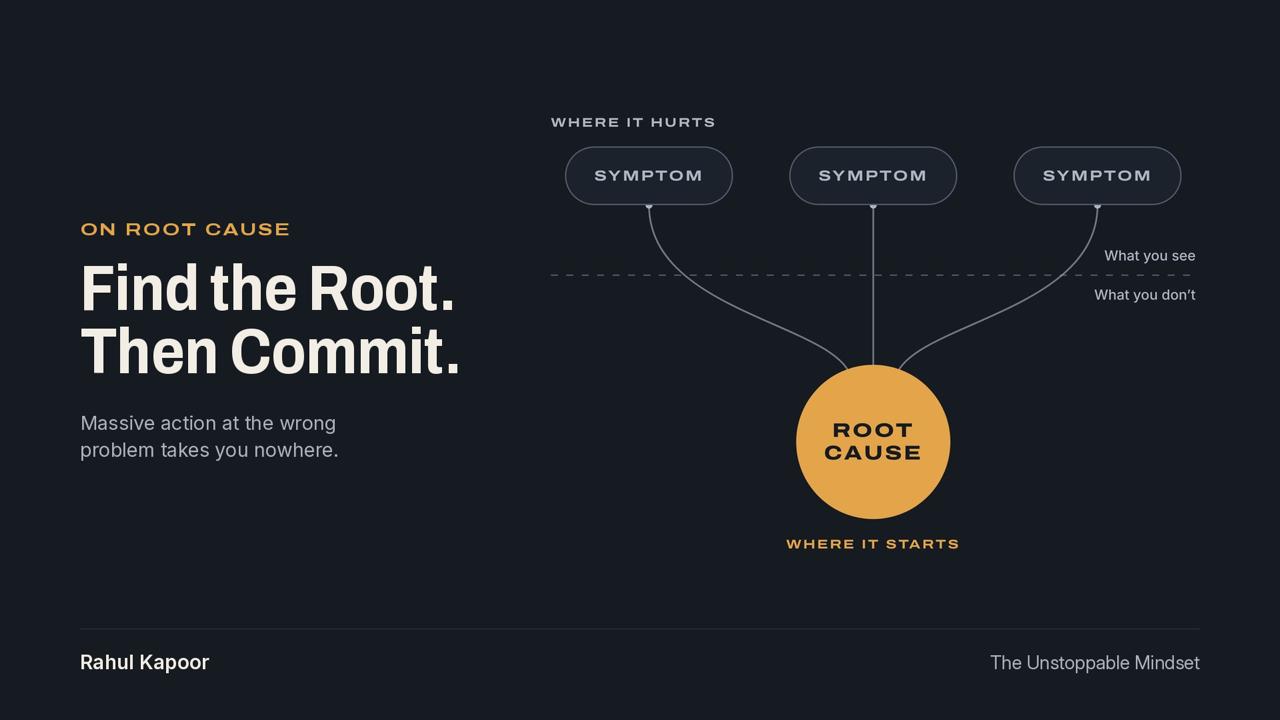
For months, I treated my tennis elbow. Then my wrist started hurting, and then my shoulder. Three problems, three treatments, sometimes three different physiotherapists, and every month things got worse. It turned out the problem wasn’t where it hurt at all.
The real culprit was a muscle that stabilises my shoulder blade. It wasn’t doing its job, so everything around it had been compensating, and those were the parts crying out. The moment we saw that, we stopped chasing the pain and started fixing the source. The rehabilitation will take three to six months, with little visible progress for weeks, but for the first time I know exactly what we are working on.
More Effort, Same Problem
You will recognise this pattern. Sales are flat, so the leader pushes the team harder. Performance slips, so the manager tightens controls. A couple has the same argument for the tenth time, just louder. Everyone is working hard, and nothing is changing.
That’s because the effort is aimed at the symptom. The sales dip may come from a product that no longer fits the market. The performance problem may be a capability gap no one has named, and the argument may be about something neither person has said out loud. Pushing harder on the symptom is like treating my elbow: it deals with where the pain shows up, not where it starts. We often mistake movement for progress.
Diagnose Before You Act
We love the idea of massive action. I believe in action too, but in my coaching the first job is almost always to step back and ask better questions:
- What exactly is the problem, and how do I know?
- What am I assuming about its cause without evidence?
- What can’t I see because I am too close to it?
- Of the possible solutions, which one is most likely to make a real difference?
Sometimes the answer lies in beliefs, values or past experiences; in business, it may lie in strategy, processes or people. And sometimes, as I learnt, you need an expert to see what you cannot. That time spent understanding can feel slow, but it changes the direction of everything that follows.
Understanding Makes Persistence Possible
Diagnosis is only the beginning. Rebuilding a muscle, a team or a habit means repeating the same work for months with little to show for it, the stretch I have called Feed Zero. What makes that bearable is knowing why you are doing it. That is not blind persistence or stubbornly repeating what isn’t working; it is committed action, guided by understanding and reviewed along the way.
This is what an unstoppable mindset demands. Don’t just work harder; understand better, then give the right process everything you’ve got. Massive action directed at the wrong problem can take you nowhere.
What are you working hard on right now that might be a symptom of a deeper problem?