Unstoppable Mindset
On Control: Where Should Your Energy Go?
By Rahul Kapoor
In April 1971, Prime Minister Indira Gandhi wanted the Indian Army to move into East Pakistan. General Sam Manekshaw later recalled telling her it wasn’t ready.
The monsoon was coming. The Himalayan passes were open, which made Chinese intervention possible. His formations weren’t prepared. He asked for time, and offered to resign rather than send his soldiers in unprepared.
He couldn’t control the crisis, the weather or the geopolitics. But he could control his army’s readiness, influence the timing of the decision and plan for what he would have to navigate.
That is a powerful lesson in leadership.
We all know the advice: focus on what you can control. Yet look at where our attention actually goes. Other people’s opinions, organisational politics, decisions made above us, setbacks we didn’t see coming.
These things matter. The problem starts when they use up the energy we need for the things we can actually change.
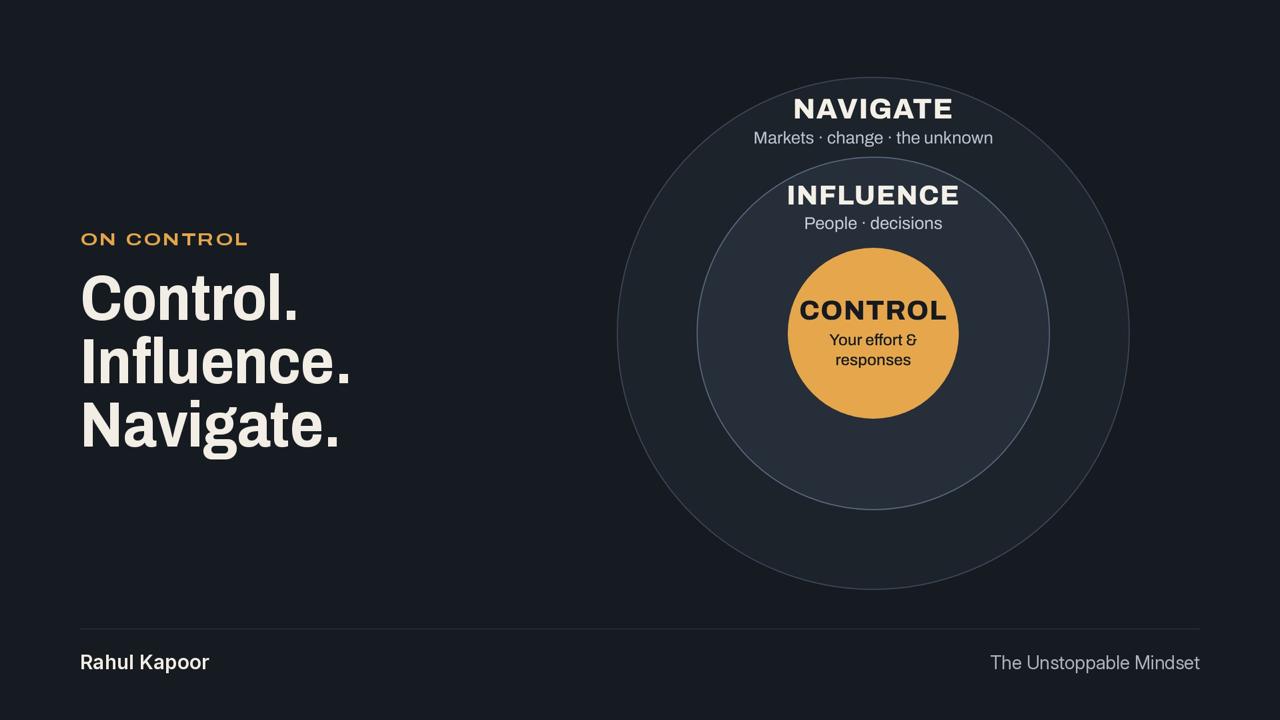
Stephen Covey described this as the difference between our Circle of Concern and our Circle of Influence. But real life rarely splits so neatly. It works in three layers.
Control: your preparation, effort, responses and standards.
Influence: what you can shape but not dictate. A colleague’s view, a client’s decision, your team’s performance.
Navigate: what lies beyond both. Market shifts, restructuring, the unexpected. You can’t change these. You can learn to move through them well.
Consider a sales leader. She cannot decide how every customer responds or how every salesperson performs. But she controls the clarity of her strategy and the quality of her coaching. She can influence capability, morale and the information her team takes into the field. When the market turns, her job is to navigate: adjust, re-plan and steady the team.
She cannot guarantee the outcome. She can shape the conditions that make better outcomes possible.
Navigating is a skill, not a mood. It rests on capabilities we can build:
- emotional steadiness, to think clearly under pressure
- adaptability, to change course when the old approach stops working
- the ability to act without waiting for every answer
None of these is fixed. Each grows through awareness, practice and feedback.
An unstoppable mindset is not about fighting every circumstance. It means knowing when to act, when to influence and when to adapt.
The next time you feel stuck, ask:
- What is within my control?
- What can I influence, even if I can’t guarantee the outcome?
- What must I learn to navigate, and what capability will that take?
Return to Manekshaw. When war came in December 1971, it was over in thirteen days. He hadn’t chosen the circumstances. He had prepared for them.
You may not choose every circumstance you face. But you can keep developing the person who faces it.
That is the work of an Unstoppable Mindset.