Unstoppable Mindset
On HYPERCONSCIOUS MINDSET: When Pressure Rises, Expand Your Thinking
By Rahul Kapoor
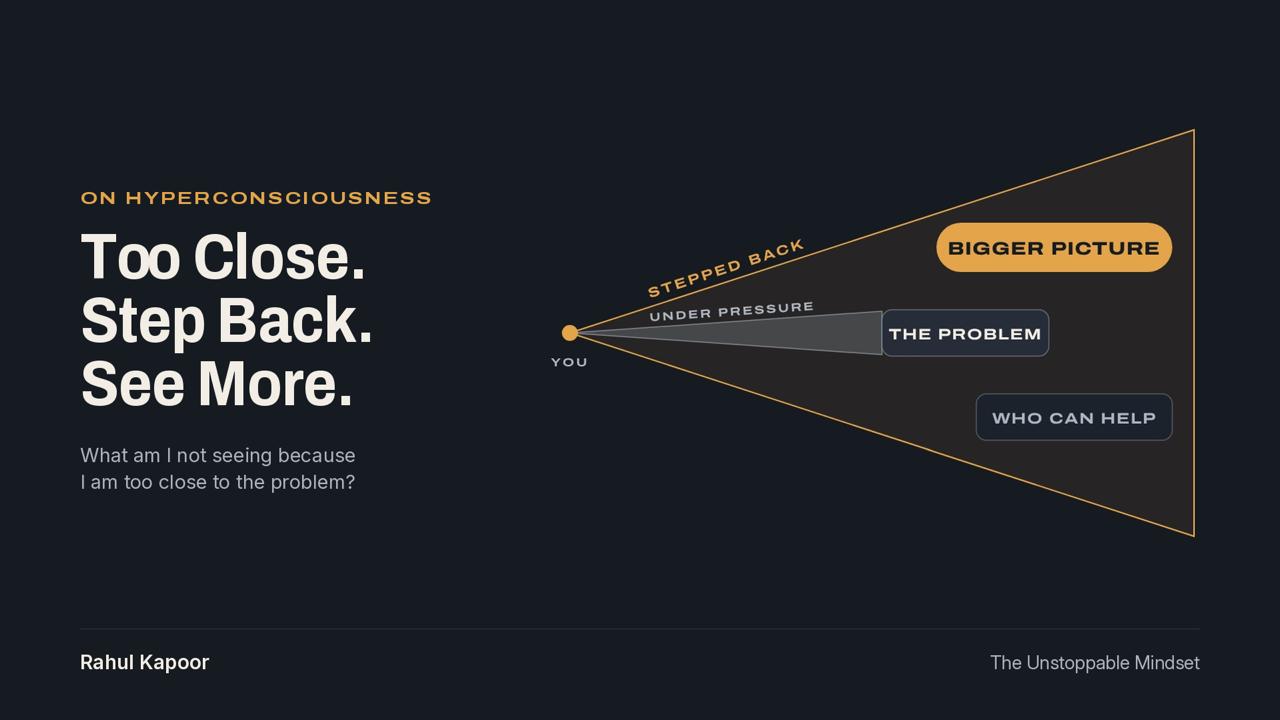
Over the years, I have had the privilege of interacting with some extraordinary people: Dr. A.P.J. Abdul Kalam, Sachin Tendulkar, Shah Rukh Khan and many exceptional business leaders. Their journeys could not have been more different, yet they had something important in common. Success does not eliminate problems; it changes the size and complexity of the problems you face. A young professional may worry about getting an opportunity, while a CEO may worry about thousands of employees, a market disruption, a regulatory challenge or a decision involving hundreds of crores.
The stakes change, but the fundamental question remains the same: how do you think when things don’t go your way? That question only matters more as you grow, because your problems don’t become fewer. They become bigger, more complex and more consequential.
What Happens Inside the Brain Under Pressure
Neuroscience offers an interesting insight here. When we experience intense stress, our attention narrows onto the immediate threat. Research on how stress affects the prefrontal cortex suggests that high stress can interfere with cognitive flexibility, working memory and our ability to regulate our responses, which are the very capabilities we need for strategic thinking and good decisions. In simple terms, pressure can make our best thinking hardest to reach at exactly the moment we need it most.
You have probably seen this in yourself or in others. We become reactive and defensive, we narrow our options, and we get so consumed by the immediate problem that we lose sight of the bigger picture. This is where I believe the Hyperconscious Mindset becomes powerful.
What I Mean by Hyperconsciousness
Hyperconsciousness is the ability to become aware of what is happening within you, step beyond your immediate perspective and consciously choose your response. It is not about being anxious or overly self-conscious; it is about seeing more, not worrying more. I think of it as three shifts.
Shift 1: From Reaction to Awareness
Before responding, notice what is happening within you. Are you looking at the facts, or are you reacting to fear, frustration or the need to prove yourself? Simply recognising the reaction creates a small gap between what you feel and what you do, and that gap is where better decisions begin.
Shift 2: From the Immediate Problem to the Bigger Picture
Ask yourself: what is the bigger problem I am actually trying to solve? A difficult employee may not simply be an employee problem; perhaps the real challenge is building a stronger leadership culture. A lost client may not simply be a revenue problem; perhaps the bigger challenge is building a business that isn’t dependent on one client. Sometimes, making the problem bigger makes the immediate problem smaller.
Shift 3: From Helplessness to Deliberate Action
Once you can see the bigger picture, turn it into action. Ask what you can influence, who can help, what you need to learn and whether you should persist, adapt or change direction. Each of these questions moves you from feeling stuck to choosing your next step.
What It Is Not
The Hyperconscious Mindset is not forced positivity. Not every problem has a silver lining, and not every setback becomes an opportunity. Some situations are simply hard, and pretending otherwise helps no one. But a wider perspective can reveal possibilities that a reactive mind cannot see, and that alone can change the quality of your next decision.
The Question to Ask Next Time
So the next time pressure rises, don’t only ask, “How do I solve this problem?” Ask yourself: “What am I not seeing because I am too close to the problem?” Sometimes the breakthrough doesn’t come from working harder on the problem. It comes from expanding your perspective enough to see it differently. That, to me, is the power of the Hyperconscious Mindset.
What is one problem you are facing right now that might look different if you stepped back and asked what bigger challenge it belongs to?